Whether you’re gathering for a retreat or running a virtual activity, both are investments. Like picking a venue your team is actually excited about, you should be looking for virtual activities that go beyond small talk and a sense of obligation. This isn’t to say virtual trivia or happy hours are obsolete, but it’s worth mixing it up. Choose activities people are genuinely interested in, something that makes them excited to show up.
For a remote team specifically, that means looking for activities that create a shared experience without requiring everyone to be in the same place, or even on camera, at the same time.
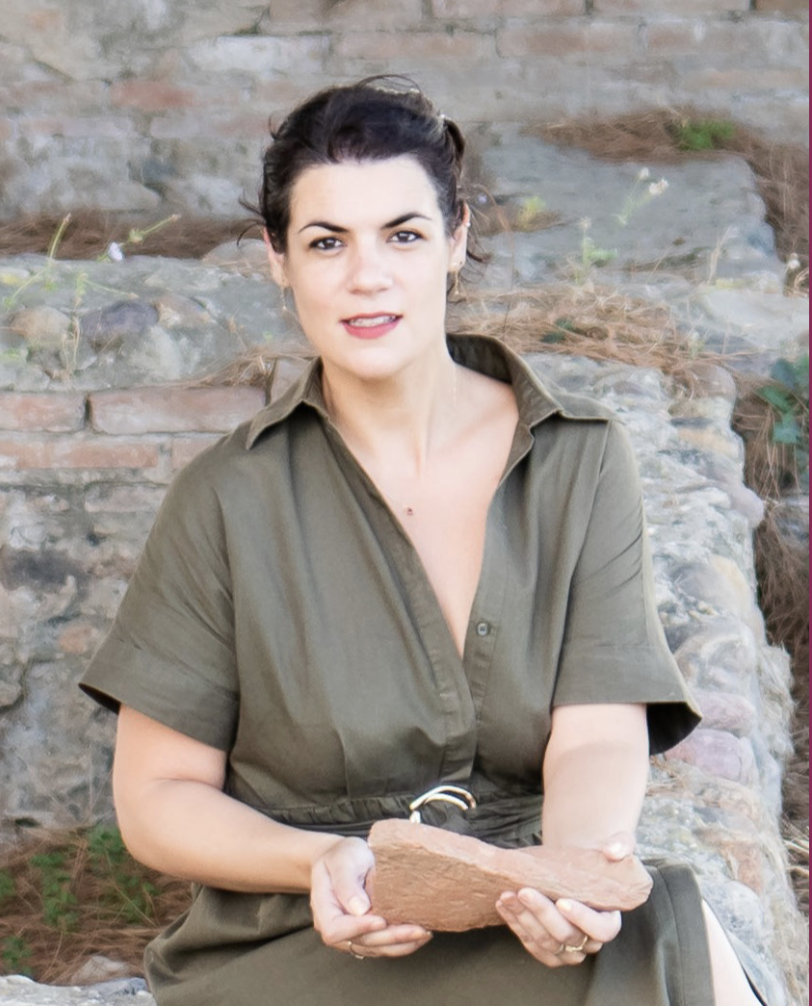
Our team recently found one: a hand reflexology and self-massage session facilitated by Dr. Celia Orsini, an archaeologist and the founder of Archaeology for Wellbeing, a consultancy that pairs the history of ritual and touch with practical wellbeing techniques. It’s an unusual pairing on paper. In practice, it turned into one of the more memorable hours our team has spent together this year.
There’s also something fitting about the timing. Most of us spend eight hours a day typing, scrolling, and gripping a mouse, and hand tension is one of those things we rarely stop to notice, let alone address. Reflexology and self-massage gave the team a practical skill for exactly that. But the bigger takeaway was less about the workday and more about the other sixteen hours: this is something people can carry with them and use for the rest of their lives, not just something to get through a stressful afternoon at a desk.
Here’s how it went.
How We Set It Up
The workshop ran for about 90 minutes over video call, with everyone joining from wherever they happened to be. Celia opened with a bit of grounding: arriving, situating yourself, taking a breath before diving in. From there, she walked the group through the history of massage and touch across different cultures before moving into a full self-hand-massage sequence.
As Glen described it, Celia led the group through “the history of massage from an archaeological perspective, showing how different cultures approached it.”
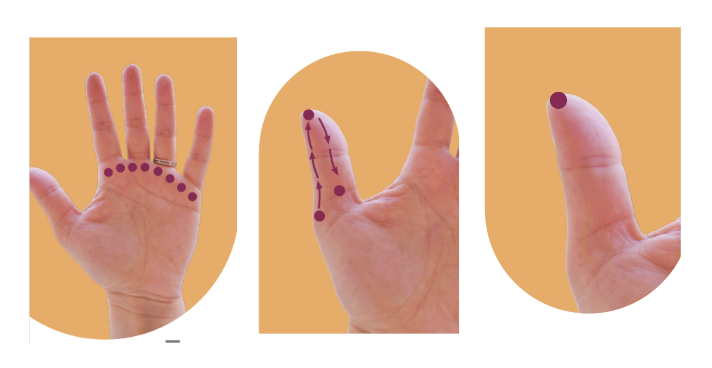
The sequence itself covered five pressure points: one below the middle knuckle for the solar plexus, a set along the palm knuckles for the diaphragm, a line along the thumb tied to the endocrine system, the very tip of the thumb held for sleep regulation, and a point at the wrist sometimes called the “spirit gate,” linked to self-care and emotional regulation.
There was also a short reflective exercise: describing your relationship with the past through a metaphor, a prompt that landed harder than expected for a group used to talking about quarterly goals, not their own history.
For anyone building a broader retreat agenda, the lesson is useful: not every activity has to be high-energy or complicated. Sometimes a quieter experience placed between more demanding sessions creates exactly the reset a team needs.
Measuring the Shift
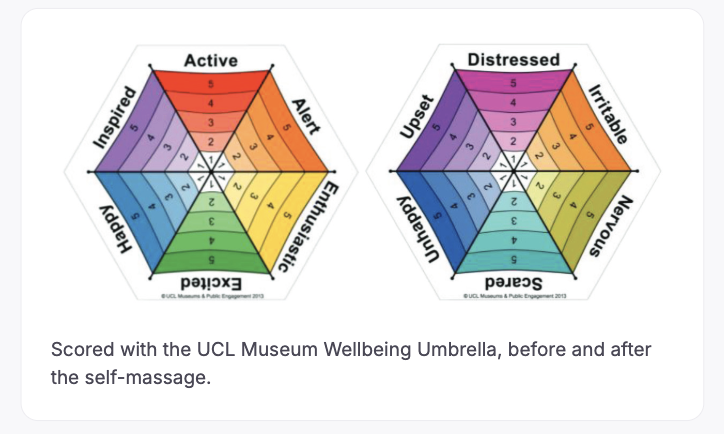
To gauge the impact, the team used the Wellbeing Umbrella, a twelve-point scale from UCL’s Museum Wellbeing Measures Toolkit. Before and after the session, everyone rated themselves across six positive feelings (active, alert, enthusiastic, excited, happy, inspired) and six negative ones (distressed, irritable, nervous, scared, unhappy, upset).
We didn’t expect a hand massage to move those numbers much. It did, more than we expected.
A few numbers from the session:
- Positive feelings across the group, up roughly 12%
- Negative feelings across the group, down roughly 57%
- Participants whose scores improved: all of them
Individually, the shifts were even more striking. One participant’s negative-feeling total dropped from 12 before the session to 4 after. Another dropped from 9 to 2. A third went from 7 down to 3. Across the board, positive feelings held steady or climbed while negative feelings fell sharply, and nobody’s numbers moved in the wrong direction.
Marina put it simply: by the end, the group felt “more relaxed and present” than when they’d started.
Julen hadn’t known what to expect going in. His takeaway afterward: “If you’re thinking about it, don’t. Just book it.”
Key Takeaways
It’s a skill, not just an experience. Most wellness add-ons end when the session does. This one hands people a repeatable sequence they can use at their own desk, on their own hands, for the rest of their working lives, not just a nice memory of a Tuesday afternoon.
It scales without extra planning. No shipping supplies, no app onboarding, and no complicated setup. One facilitator, one call, everyone’s own two hands. For a distributed team, that’s a rare thing to find in a wellness activity.
The history made it stick. Framing the practice through archaeology, rather than as generic wellness content, gave the session a point of view. It’s a genuinely interesting way to think about a practice most of us associate purely with modern spa culture, and it’s the detail people were still bringing up afterward.
The scoring made the value provable. Asking people to rate themselves before and after turned a nice 90 minutes into something with a measurable result, which matters if you’re the one deciding whether to bring in a session like this again.
What This Means for Your Next Gathering
It’s not a replacement for a company retreat. Nothing is. But as a way to give a remote team something genuinely restorative between the bigger gatherings, it’s one of the more effective things we’ve tried, and one worth having in rotation alongside the trivia nights and happy hours.
The same thinking applies to choosing themes for a larger gathering. Activities tend to feel more intentional when they support the reason people are getting together rather than being added simply because an itinerary has an empty hour.
That becomes even more important with large company retreats, where organizers have to find experiences that remain accessible and meaningful as attendance grows.
The type of gathering matters too. A SKO may be centred around strategy, training, and sales goals, but a quieter wellness session can provide useful contrast between information-heavy sessions.
Reward travel requires a different approach. A President’s Club Trip should feel like a reward rather than another mandatory company event, so experiences need to be memorable without feeling overly programmed. Strong incentive travel planning accounts for that balance.
Planners also need to consider how their budget reaches the attendee experience. Understanding commission free pricing models for company retreats can help teams evaluate what they are actually paying for and where more of the budget can be directed toward activities, food, accommodations, and experiences.
And while an activity like hand reflexology is intentionally simple, larger retreats often require a broader operational stack. Our guide to tools for company retreats covers some of the technology and planning resources that can help coordinate the rest of the experience.
If you’re building out a calendar of team activities and want something that isn’t another conventional video call, this is worth a look. You can find Dr. Celia Orsini and Archaeology for Wellbeing at https://www.archaeology-for-wellbeing.com.
FAQs About Hand Reflexology and Unique Team Activities
What is hand reflexology for teams?
Hand reflexology is a guided activity involving massage, touch, and pressure points on the hands. In a team setting, participants can follow the facilitator using their own hands, which makes it particularly easy to run remotely. Unlike some wellness activities, it also gives participants techniques they can continue using after the session is over.
What is Handology?
Handology can broadly describe practices or learning centred around the hands, although it is not one standardized professional discipline. Depending on the activity, more specific terms such as hand reflexology, hand massage, or hand wellbeing workshop may be more accurate. What made our session unusual was the combination of hands-on techniques with archaeology, history, and cultural context.
Is hand reflexology a good virtual team-building activity?
It can work particularly well for remote teams because there is almost no logistical barrier to participation. People don’t need equipment shipped to them, specialized software, or a large physical space. Everyone can participate from home while still sharing the same experience.
What are some unusual team-building activities for remote teams?
Unique remote activities can include hand reflexology, guided drawing, cooking workshops, interactive storytelling, cultural demonstrations, virtual escape rooms, meditation, music sessions, and specialist-led history workshops. The strongest options give people something to actively experience together rather than simply creating another meeting where everyone is expected to talk.
What are good wellness activities for corporate teams?
Wellness activities can include yoga, meditation, stretching, breathwork, massage workshops, sound experiences, guided nature activities, and reflexology. The right activity depends on the team’s needs, accessibility requirements, and whether the goal is relaxation, movement, learning, or social connection.
How do you choose a good team activity?
Start with the outcome rather than the activity itself. Decide whether you want people to relax, collaborate, laugh, learn something new, or simply spend time together outside their normal working relationships. From there, choose an activity that supports that purpose without requiring unnecessary logistics.
Can virtual activities complement an in-person company retreat?
Yes. Virtual activities can help maintain connection between larger in-person gatherings rather than trying to replace them. A company might hold one or two major retreats each year while using smaller remote experiences throughout the year to give distributed employees additional opportunities to interact.
How do you measure whether a team-building activity worked?
You can measure more than attendance or whether people said they enjoyed themselves. Short before-and-after surveys, wellbeing ratings, participation levels, qualitative comments, and whether employees would voluntarily do the activity again can all provide useful signals. In our session, measuring wellbeing before and after made the impact much easier to see.