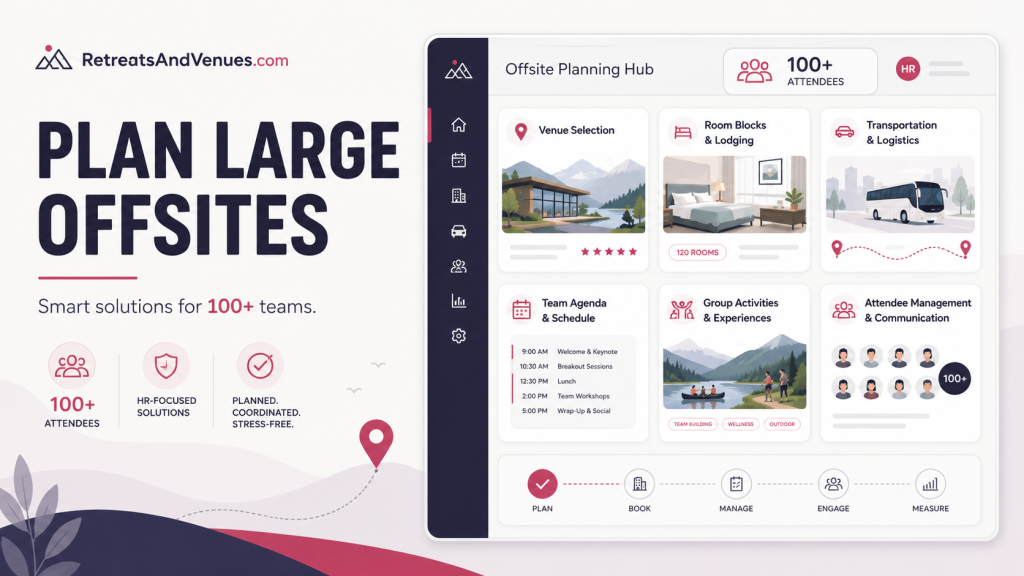
The most expensive mistake in planning a large company retreat isn’t booking the wrong venue. It’s starting the search four months out when you needed nine — and then making every subsequent decision under pressure because the window has already closed.
It plays out the same way each time. A company wants to bring 120 people together for their annual offsite. Someone gets tasked with planning in January for a May event. By the time there’s internal alignment on budget, the mountain lodge they wanted is already booked. The backup resort has a food and beverage minimum nobody accounted for. The agenda gets shaped around whatever venue said yes last, and the experience is fine but forgettable. Nobody points to the timeline as the culprit — but it was.
Planning a large company retreat requires a fundamentally different approach than planning a small team offsite. The complexity doesn’t just scale up, it compounds. Venue options narrow. Contract exposure grows. Travel coordination across multiple cities becomes its own project. And the stakes for the employee experience are higher, because a retreat that lands well for 120 people creates a cultural moment the company carries for months. One that doesn’t lands with a thud people remember just as clearly.
This guide covers what HR professionals and people ops teams actually need to know: how to source venues at scale, what to realistically budget, how to build an agenda that holds a large group’s attention, and where the planning process most commonly breaks down. RetreatsAndVenues helps companies source, compare, and book retreat venues for larger teams — and that experience informs everything that follows.
Whether it's a leadership offsite or a team wellness retreat, we'll help you find venues that fit your theme, budget, and group size.
Get free expert guidanceWhat Makes a Large Company Retreat Different
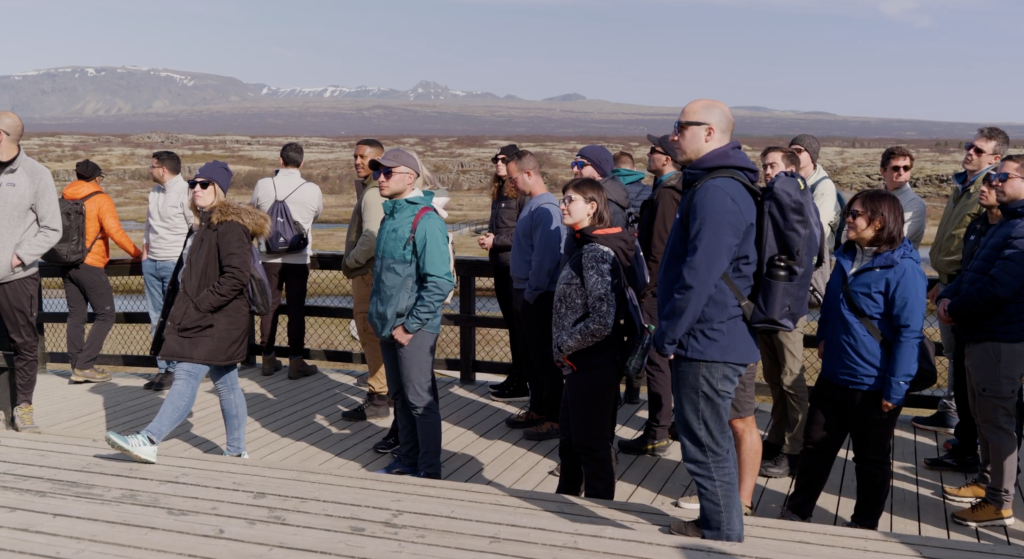
What counts as “large” is relative. For a 30-person startup, 50 employees is a major undertaking. For an enterprise, “large” might mean 300-plus. The practical threshold is less about headcount and more about when the complexity compounds — when venue options start to narrow, when individual spreadsheet tracking breaks down, and when you can no longer manage logistics informally. Most teams hit that point somewhere between 50 and 100 attendees.
The bigger shift is qualitative. A large company retreat has to work for a much wider range of people simultaneously — different functions, seniority levels, personalities, physical abilities, and expectations. An engineer who wants outdoor adventure activities, a finance manager who prefers structured work sessions, and a new hire who just wants to meet people are all at the same event. The design has to account for all three. Done well, it’s one of the most powerful investments a company can make in its people. Done poorly, it’s a very expensive way to confirm that nothing changed.
Why Companies Plan Large Retreats

Understanding the purpose before sourcing a single venue isn’t just good practice — it changes every downstream decision. A retreat without a clear goal produces an agenda that tries to do everything and accomplishes less than it could.
The most common reasons companies invest in large company retreats:
- Culture and connection — for remote and distributed teams especially, the accumulation of Slack messages and Zoom calls sustains operations but rarely builds the trust and shared identity that makes organizations cohesive. According to a Harvard Business Review study, face-to-face communication is 34 times more effective than email at building trust and connection.
- Strategic alignment — a large annual retreat is often the most efficient vehicle for communicating company direction to a large number of people in a format that allows genuine dialogue.
- Cross-functional relationships — a retreat is one of the few contexts where an engineer, a finance manager, and a sales rep from different regions spend three days in the same place having real conversations. Those connections show up later in how quickly problems get solved.
- Celebrating milestones — funding rounds, record revenue years, company anniversaries. The risk is organizing a celebration retreat and packing it with strategy sessions. Overloading the agenda at a milestone event is one of the more reliable ways to communicate that leadership values output over people, even when that’s the opposite of the intention.
- Reducing remote disconnection — consider a fully remote team spread across four continents with strong engagement scores on paper. When a team like that finally meets in person, they often discover entire departments have been operating with misconceptions about each other’s priorities for years. Tensions that read as “process disagreements” in Slack turn out to be something simpler: people who have never actually talked. The culture work happens at dinner and around the fire pit, not in the strategy sessions.
Once the why is clear, the how gets considerably more manageable.
How to Plan a Large Company Retreat: The Checklist
The planning process for a large retreat has a clear sequence of dependencies. Getting decisions in the right order is the practical difference between a retreat that comes together cleanly and one that creates a crisis every two weeks until the event date.
Define the goal first. A team-building retreat needs shared activities and unstructured time. A strategic alignment retreat needs long plenary blocks and strong AV. A wellness retreat prioritizes environment and pacing. Mixing these goals without acknowledging the tradeoffs produces an agenda that serves none of them well — and a group that leaves feeling vaguely unsatisfied without being able to say why.
Set attendance rules early. Who is invited, whether attendance is mandatory, whether it’s whole-company or department-specific — these decisions have direct implications for venue search, budget, and agenda design. They’re also difficult to reverse once a venue is under contract.
Source venues before locking dates. Date selection for large retreats is a competitive question, not a scheduling one. The venues that can realistically accommodate 100-plus people in one place — sleeping, meeting, and dining together — book on annual cycles. Identify a preferred window, then confirm what’s available before locking the internal calendar.
Build a full budget, not just a room rate. A realistic budget covers accommodations, meeting space (often charged separately), food and beverage including required minimums, activities, ground transportation, AV and production, taxes and service charges, corporate retreat gifts if relevant, and a contingency buffer of 10 to 15 percent. Budget conversations that start with only the accommodation cost consistently produce surprises at the contracting stage.
Send RFPs to multiple venues simultaneously. The only way to make a well-informed venue decision is to compare comparable proposals. Two venues at the same nightly rate can differ by 30 to 40 percent in total landed cost once food and beverage minimums, service charges, and taxes are factored in. The planning team that compares nightly rates picks the lower number and almost always spends more.
Build the agenda in parallel with sourcing. The agenda informs what meeting spaces you need, which affects which venues belong on the shortlist. Don’t wait for a signed contract to start thinking about programming.
Choosing the Right Venue for 100+ People
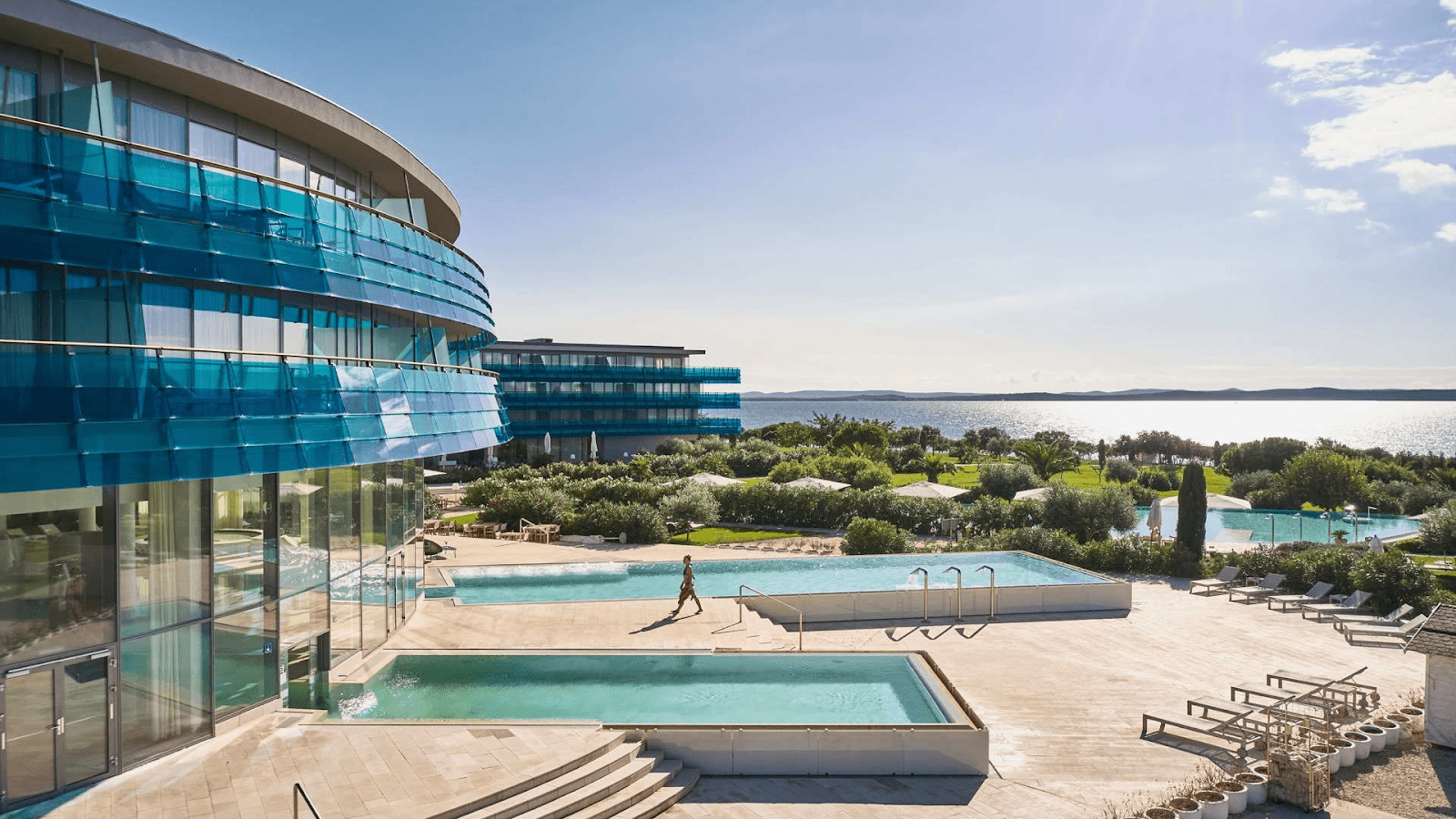
Finding the right corporate retreat venue for a large group is not a Google search problem — it’s a filtering problem. The properties that work at this scale represent a small subset of the total market. General listing platforms surface too many irrelevant options. Direct hotel outreach without a structured RFP produces proposals that aren’t comparable.
The single most important rule: keep everyone on the same property. Splitting a group across a main venue and an overflow hotel is almost always a mistake, even when it appears to solve a capacity problem. The spontaneous hallway conversations, the breakfast table introductions, the hour around the fire pit before dinner — that’s where the actual retreat value gets created. It disappears when part of the group has to make a conscious decision to travel between properties.
What to evaluate beyond room count:
- Meeting and breakout space — a main session room for the full group, breakout rooms for small-group work sessions, informal gathering areas, and a private space for executive leadership sessions if needed. The square footage in the brochure doesn’t always reflect how the space functions when a large group moves through it across multiple days.
- Dining capacity — can the venue serve the full group efficiently? Handle dietary restrictions at volume? A group breakfast for 120 people that takes two hours to get through disrupts the entire day’s agenda.
- Accessibility — distance from major airports, ground transportation logistics, arrival and departure windows. A stunning remote venue that requires a connecting flight and a two-hour transfer is a harder sell for 150 people than it is for 20. Also, physical accessibility of the venue is important as well. Making sure seating, restrooms and venue accommodations are friendly to all folks can make or break the feeling of the retreat.
- Outdoor activities — kayaking, hiking, ropes course, zipline — these require terrain and infrastructure that not all properties have. Evaluate them as part of venue selection, not as an afterthought.
- Contract terms — deposits, cancellation terms, attrition clauses, food and beverage minimums, service charges. These details turn a well-negotiated rate into a contract surprise if they’re not reviewed carefully before signing.
Best venue types for large groups:
Resorts offer the most complete infrastructure — guest rooms, dining, meeting space, and activities in one place — and are the most commonly used for large corporate retreats. The tradeoff is cost and the risk of a generic feel if the retreat experience isn’t designed thoughtfully on top of the property.
Ranches, lodges, and outdoor retreat venues have become increasingly popular as a unique type of retreat, particularly for teams that want an experience that contrasts meaningfully with remote work life. These venues tend to have strong fire pit culture, access to outdoor adventure activities, and an atmosphere resorts can’t manufacture.
Conference hotels are the right choice when the agenda is dense and structured and the environment is secondary. Strong AV infrastructure, flexible meeting rooms, professional event services. Not the choice when the experience itself is part of the purpose.
Boutique hotels with buyout potential — taking over a 40 to 60 room property entirely — offer a retreat environment that feels curated and private in a way shared resorts can’t replicate. They rarely work above 100 people, but for departmental or leadership retreats they’re among the most effective options available.
What Does a Large Company Retreat Cost?
Costs vary significantly based on destination, group size, number of nights, and venue category — but the budget typically breaks down like this (RetreatsAndVenues, 2025; Allied Market Research, 2024):
- Accommodation: 30–35% of total spend
- Transportation: 20–25% including flights and ground transfers
- Food and beverage: ~20%
- Activities and team building: ~20%
- Miscellaneous (AV, materials, gifts, contingency): 5–10%
Based on analysis by The Offsite Co. of over $100 million in managed corporate retreat spend, a realistic on-site benchmark is $750 to $850 per person per night, not including flights. For a four-night retreat with 100 people, that’s $300,000 to $350,000 before travel. All-in per-person costs for domestic retreats typically land between $2,000 and $4,000 (RetreatsAndVenues, 2025), with international retreats reaching $5,000 and above.
Planning in shoulder season — late April, May, October, or November — typically delivers 25 to 35 percent savings at nature-based and countryside venues compared to peak months (Allied Market Research, 2024). Choosing a destination with direct flight connections for the majority of your attendees has an outsized effect on total transportation spend.
How Far in Advance to Start Planning
The timing question comes up in almost every large retreat conversation, and the answer is almost always: earlier than you think.
For groups of around 50, three to six months is often workable. For 100-plus, six to nine months is the realistic minimum — not a best practice, but a practical necessity. For 200-plus, or any retreat requiring international travel coordination, start nine to twelve months out. The venues that can accommodate large groups in a single location book on annual cycles, and the gap between “we started sourcing” and “we signed a contract” is typically several months even under good conditions.
Consider what a late start actually costs. A team that wants a mountain lodge property in September in Colorado — peak season in one of the most in-demand retreat destinations in North America — and begins sourcing in June will find every suitable property already committed. What’s left is either significantly more expensive, because venues know they can charge a premium for late availability, or it’s the inventory other companies passed on. They end up somewhere that technically works but feels nothing like what was envisioned, often at a higher cost than the original property would have been with a January start.
Start late and you’re not just limited on venue options. You’re also paying rush pricing on flights, you have reduced negotiation leverage with venues that know you’re under time pressure, and every downstream planning task — agenda development, travel coordination, attendee communication — gets compressed into whatever time is left.
Agenda Design for Large Groups

The agenda is the architecture of the retreat experience. A great venue with a bad agenda still produces a disappointing retreat.
The most common failure mode for large group agendas is treating 100-plus people as a single audience for three days straight. Assigning attendees to stable small cohorts of 15 to 25 people — groups that persist across the retreat rather than reshuffling for each session — gives people a consistent community within the larger gathering and creates the conditions for genuine connection alongside the plenary moments.
A practical allocation for most large retreats: strategic and work sessions at roughly 50 percent of the schedule, team-building activities at 30 percent, and genuine downtime at 20 percent. Mornings work best for cognitive-heavy strategy work. Afternoons are better for activities. Evenings belong to informal social connection — the fire pit, dinner, the bar. Research on cognitive performance suggests attention spans peak at roughly 90-minute intervals before productivity drops, so build breaks accordingly.
Take a 200-person team brought together at a resort with an agenda packed wall to wall — general sessions, department breakouts, workshops, an evening program every night. By day three, people are skipping optional sessions to sit by the pool. Not because they’re disengaged from the company, but because they’re human. The sessions they remember six months later aren’t the strategy presentations. They’re the conversations that happened at lunch when there was nowhere else to be. Over-programming doesn’t signal investment — it signals that leadership didn’t trust the environment and the people to do the work on their own.
The post-retreat integration session is the agenda item most frequently dropped when schedules run tight. Don’t drop it. Companies that see measurable returns from retreat investment typically dedicate a protected block on the final day to translating insights into implementation plans with clear ownership. Without it, decisions made during the retreat fade within weeks.
How Company Retreat Planning Changes by Group Size
“Large company retreat” can describe anything from a 50-person offsite to a global gathering of 500 or more employees, but those events should not be planned in the same way. Each increase in headcount changes the number of suitable venues, the amount of infrastructure required and the financial consequences of getting the details wrong.
The most meaningful thresholds are not arbitrary. They represent the points at which informal planning systems begin to break down. A 30-person company can often make decisions in one conversation and move everyone in a few vans. A 150-person company needs coordinated room blocks, breakout spaces and transportation schedules. At 500 attendees, the company may be managing several hotels, a professional production programme and what amounts to a temporary transportation network.
The following ranges show how the retreat-planning model changes as the group grows.
Planning a Company Retreat for 20 to 50 People
A retreat for 20 to 50 employees is large enough to require deliberate planning, but still small enough to preserve the intimacy that makes an offsite feel different from a conference. Most attendees can participate in the same workshops, eat together and move between activities without being divided into complicated rotations. This gives organizers considerable freedom to design the retreat around culture, conversation and shared experiences.
At this size, the venue search often begins with a relatively straightforward question: can the property accommodate the entire team comfortably? Organizers should confirm the number of bedrooms, whether single or shared occupancy is expected, the size of the main meeting room and whether the group can dine together. A venue that offers one central gathering space, attractive common areas and easy access to activities may be more valuable than a conventional conference hotel with numerous smaller rooms.
Prioritize intimacy and shared space
For groups under 50, the layout of the property often matters more than the total amount of meeting space. The retreat should make it easy for employees to cross paths naturally, sit together after formal sessions and continue conversations over meals or during downtime.
A large hotel may offer more amenities, but it can disperse the team across different floors, restaurants and public areas. A smaller hotel, lodge, villa or buyout property can make the experience feel more cohesive. Exclusive use is not always necessary, but it becomes attractive when privacy, company culture or evening programming is central to the retreat.
The RetreatsAndVenues podcast repeatedly shows how much of a retreat’s value emerges outside the formal programme. In the episode about Huzzle’s first retreat, a group of only seven or eight employees used co-working, city exploration and unstructured time in Lisbon to reset the dynamics of a fully remote team. In another episode, Awork CEO Tobias Hagenau describes an unplanned night of salsa dancing as one of the most memorable moments of the company’s offsite. These examples reinforce an important lesson for smaller groups: do not schedule every minute. Informal interaction is part of the programme, even when it does not appear on the agenda.
Keep the agenda collective
A 20-to-50-person group can usually remain together for most strategic discussions, cultural exercises and social activities. Breakouts may still be useful, but they can often happen around a few tables or in nearby corners rather than in separately contracted meeting rooms.
This creates an opportunity to build a coherent emotional arc across the retreat. The team can begin with shared business context, move into smaller discussions and reconnect for meals or activities without employees feeling that they attended entirely different events. The retreat can feel like one collective experience rather than a programme made up of parallel tracks.
The Brand Guild offers one example of an activity designed for a group of up to 55 employees. Its “Build a Brand” challenge divides attendees into smaller cross-functional groups, but everyone participates in the same overall experience and reconvenes around a shared outcome. The activity scales collaboration without fragmenting the retreat.
Transportation and communication can remain relatively simple
Airport transfers for 20 to 50 attendees may be handled with a small number of vans, minibuses or scheduled group pickups. Attendee communication can often run through a shared itinerary, a central email sequence and a group messaging channel.
That does not mean the logistics can be improvised. Organizers should still collect arrival information, dietary requirements, accessibility needs and emergency contacts before the retreat. However, changes can usually be communicated to the whole group without building a complex registration platform or segmenting people across several hotels and activity tracks.
Pre-retreat surveys are especially valuable at this size because organizers can still respond meaningfully to individual preferences. In the Pioneers in Culture podcast, Meaghan Williams describes surveying employees about food, activity comfort and timing so the programme works for different personalities and needs. That input helps prevent a retreat from being designed only for the most vocal or extroverted attendees.
What matters most for 20 to 50 people
The central question is:
Will this venue and agenda help the whole team spend meaningful time together?
For this group size, the greatest planning risk is usually not insufficient infrastructure. It is creating an agenda that feels like an ordinary workday in a different location. Venue atmosphere, shared meals, purposeful activities and unscheduled time should receive as much attention as meeting-room specifications.
RetreatsAndVenues can help widen the venue search beyond conventional hotels, including properties that can accommodate the full group in a more private or experience-led setting. Its venue platform is designed to help teams compare properties, meeting spaces, amenities, destination logistics and activity options without relying on an unstructured collection of search results and email threads.
Planning a Company Retreat for 50 to 100 People
Between 50 and 100 attendees, the retreat begins to outgrow informal planning. The group may still be able to gather in one plenary room and share many of the same experiences, but movement, dining, breakouts and attendee communication require greater structure.
This is often the range in which a retreat stops feeling like a large team trip and begins to resemble a small internal event. The planning team should still protect intimacy and connection, but it must also test whether the venue can handle the group operationally.
Meeting space becomes more than one room
A venue may have enough bedrooms for 80 people without having the spaces required to run an effective programme. Organizers should look beyond the headline capacity and evaluate how the property functions throughout the day.
A 50-to-100-person retreat may require:
- One plenary room that comfortably accommodates the whole company
- Two to five breakout spaces for departmental or working sessions
- Pre-function space for coffee, registration and informal conversations
- Indoor alternatives for weather-dependent activities
- A private dining room or restaurant area
- Space for organizers, equipment and luggage
Room layout matters alongside capacity. A room advertised for 100 people may reach that number only in a tightly packed theatre arrangement. It may accommodate far fewer attendees when tables, staging, audiovisual equipment or collaborative seating are added.
The group may need controlled divisions
At 30 people, organizers can change the programme verbally and expect everyone to follow. At 80 people, uncertainty begins to create queues, missed sessions and uneven experiences. Attendees may need to be assigned to breakout groups, activity rotations, airport transfers or dining tables in advance.
The goal is not to over-engineer the retreat. It is to create enough structure that employees do not spend their time wondering where they are supposed to be. Colour-coded groups, clear itineraries and a single source of truth can preserve the ease of a smaller retreat while preventing avoidable confusion.
Catering needs a realistic service plan
The venue should be able to serve the full group within the time provided by the agenda. A restaurant may seat 80 guests, but that does not necessarily mean its kitchen can serve 80 plated meals at the same time or handle dozens of dietary modifications efficiently.
Organizers should ask how the venue normally handles groups of this size, including:
- Whether meals are buffet, family-style or plated
- How dietary requirements are labelled and distributed
- How many coffee or buffet stations will be available
- Whether meals can be served privately
- How long the venue needs to complete service
- Whether bars and evening functions require additional staffing
Food service is part of the event flow. When breakfast runs late or lunch creates a long queue, the problem affects every session that follows.
Exclusive areas become more valuable
A group of 60 or 80 employees can easily dominate a restaurant, lobby or pool area without having formal exclusivity. Sharing those areas with holiday travellers, weddings or another corporate group can affect privacy and make the retreat feel disjointed.
A full-property buyout may not be required, but the company should clarify what will be exclusive. A dedicated meeting floor, private dining area, reserved terrace or separate wing can provide much of the control of a buyout without the full cost.
Organizers should also ask whether other events will be taking place at the property. Two companies running evening programmes in adjacent spaces can create noise, branding and scheduling conflicts even when both events technically fit.
Internal ownership needs to be clearer
A single organizer may still lead the retreat, but several responsibilities should be assigned before arrival. One person might own travel information, another the agenda, another venue communication and another attendee questions.
This does not require a large event department. It requires avoiding a situation in which every problem flows to the same person. At 80 attendees, a handful of missing room keys, late flights and dietary questions can consume the organizer’s entire arrival window.
What matters most for 50 to 100 people
The central question becomes:
Can the venue preserve a shared retreat experience while supporting the group’s growing operational needs?
This is the point at which comparing properties by room rate alone becomes particularly risky. The strongest venue may be the one that offers a better meeting layout, private dining, simpler transfers or fewer mandatory suppliers—even when its initial nightly price is higher.
RetreatsAndVenues can help organizers compare the full fit of each property rather than treating guestrooms, meeting rooms, destination access and activities as separate searches. This is especially helpful when the planning team needs to understand why a property that appears large enough on paper may not work for the intended agenda.
Planning a Company Retreat for 100 to 500 People
For a company retreat of 100 to 500 attendees, the planning model changes—not just the venue size. A retreat under 50 can often be managed like an elevated group trip. A retreat in this range behaves more like a small conference, with greater operational, contractual and logistical complexity.
The challenge is not simply accommodating more people. Guestrooms, meeting spaces, catering, transportation and programming must all work at the same scale and at the same time. A property may sleep 250 guests but still be unsuitable if its ballroom holds only 150, its restaurant requires split meal sittings or its loading area cannot handle several coaches.
Venue capacity becomes multidimensional
Organizers should evaluate each form of capacity separately:
- Total guestroom inventory
- Single-occupancy and shared-occupancy availability
- Plenary capacity in the required seating layout
- Number and size of simultaneous breakout rooms
- Dining capacity for the whole group
- Indoor weather-backup space
- Registration and pre-function areas
- Production offices, storage rooms and staff spaces
The relationship between these spaces is equally important. Ten breakout rooms located across several buildings may technically meet the requirement but create long transitions and make the programme difficult to manage. A venue with slightly less total space may work better when its rooms are concentrated around one central conference area.
Exclusive use becomes a strategic decision
At this scale, another group can materially affect the retreat. Shared restaurants, limited evening-function space, competing audiovisual schedules and crowded public areas may undermine privacy and operational control.
Companies may prioritize:
- A full-property buyout
- Exclusive use of a hotel wing
- A dedicated conference floor
- Private restaurants or dining rooms
- Reserved outdoor areas
- Restrictions on simultaneous corporate events
Exclusivity should be evaluated as an operating advantage, not merely a luxury. When the company is the venue’s primary group, branding, meal times, staffing and space changes are often easier to coordinate.
Transportation becomes a system
Moving 150 or 300 employees requires more than ordering several buses. The planning team needs to understand when people are arriving, how quickly the venue can receive them and what happens when flights are delayed.
The transportation plan may include:
- Flight manifests organized by airport and arrival time
- Airport meet-and-greet staff
- Staggered coach departures
- Accessible vehicles
- Luggage handling
- On-site dispatch support
- Backup vehicles
- Loading and parking plans
- Separate schedules for activities and departures
Destination accessibility therefore matters differently. A secluded property can be compelling for 30 people, but the same remoteness may create substantial cost and risk for 300. Direct flights, transfer times and local transportation capacity should be evaluated before the team becomes attached to a venue.
Food and beverage becomes an operational test
The kitchen and service team must be able to deliver meals within the retreat schedule. Organizers should ask whether the venue regularly serves groups of the proposed size, rather than accepting its maximum banquet capacity at face value.
Important questions include:
- Can the whole group dine together?
- How many buffet and beverage stations will be provided?
- How quickly can the room be served?
- How are dietary meals identified and delivered?
- Can coffee stations be replenished during peak breaks?
- Is the kitchen shared with other events?
- What additional staffing or equipment is required?
A venue that performs well for a 40-person dinner may struggle to serve 250 people within a one-hour meal period.
Production infrastructure becomes more important
A television and portable speaker may be sufficient for a small retreat. At several hundred attendees, visibility, sound and presentation flow usually require professional production.
The programme may need:
- Staging
- Multiple microphones
- Large projection screens or LED walls
- Professional lighting and sound
- Confidence monitors
- Recording or livestreaming
- Dedicated technical operators
- Higher-capacity internet
- Backup equipment and power
The company should confirm whether it must use the venue’s in-house or exclusive audiovisual supplier. Mandatory production providers, rigging fees, internet charges and power requirements can materially change the cost of a proposal.
Breakout planning becomes central to the agenda
A retreat of 100 to 500 employees rarely works as one continuous general session. Different departments, regions and working groups need opportunities to discuss how the company’s direction applies to them.
Organizers should confirm how many sessions must happen simultaneously and what each room requires. They should also test room proximity, sound isolation, furniture layouts and reset times.
The Pioneers in Culture episode featuring Pauliina Löytty describes a 250-person retreat in Berlin where employees were brought into the planning mindset and helped to understand the intended structure of the day. Business sessions in the morning moved into an evening celebration, but the programme worked because attendees understood its purpose and rhythm. The lesson is that larger retreats need more than logistics: employees should feel like informed participants rather than passengers being moved through a schedule.
Contracts carry more financial exposure
A 200-person retreat may involve hundreds of room nights, a significant food-and-beverage minimum, meeting-room commitments and several staged deposits. Small percentage differences can therefore represent substantial amounts of money.
Contracts may include:
- Room-block attrition
- Food-and-beverage minimums
- Cancellation schedules
- Rebooking terms
- Force-majeure language
- Meeting-room rental
- Resort and destination fees
- Service charges and taxes
- Complimentary-room ratios
- Staff-room rates
- Exclusive-vendor requirements
Venue proposals should be normalized before comparison. One hotel may waive meeting-room rental in exchange for a higher food-and-beverage commitment, while another presents a lower room rate but adds mandatory resort, audiovisual and porterage charges. The lowest headline price is not necessarily the lowest total cost.
Staffing and attendee communication become formal functions
A retreat in this range usually needs designated owners for registration, transportation, production, activities, communications and venue coordination. Depending on the programme, the company may also need executive support, an emergency contact and on-site event staff.
Attendees need a clear source of truth for schedules, rooming, dress codes, transportation, dietary information and activity assignments. A retreat website, registration portal, event app or structured email system may replace the informal email chains used for smaller groups.
Activities must scale without becoming impersonal
An activity that is engaging for 30 employees may turn 250 people into spectators. Organizers should ask not only whether an activity provider accepts a group of that size, but how many people will be actively participating at one time.
The programme may require parallel choices, rotating groups, different physical-intensity levels and several facilitators. Accessibility and weather backups should be built into the design from the beginning.
The strongest large-group activities often create smaller moments within the larger event. Fairmarkit’s retreat, discussed in the Pioneers in Culture podcast, used HBDI thinking-style assessments to form teams for a bike-building challenge. The arrival of local children who received the completed bikes gave the activity emotional meaning beyond competition. The example shows how structure and purpose can make a scaled activity feel personal.
The venue search needs to begin earlier
The number of viable properties narrows rapidly when a company needs hundreds of guestrooms, large plenary space, multiple breakouts and dining capacity on the same dates. The search may need to begin 12 to 18 months in advance, particularly when:
- Dates are fixed
- Single occupancy is required
- The destination has limited large hotels
- The retreat takes place during peak season
- A buyout is preferred
- The company needs extensive breakout or production space
The existing RetreatsAndVenues large-retreat guide makes the same underlying point: complexity compounds as the group grows, venue options narrow and starting too late forces the agenda to conform to whatever inventory remains.
What matters most for 100 to 500 people
The central question is:
Can the venue’s guestrooms, meeting space, catering, transportation and operating team function as one coordinated system?
RetreatsAndVenues can support this process by sourcing properties against the complete brief, requesting comparable proposals and helping planners evaluate operational fit alongside price. For a group of several hundred people, narrowing the search to genuinely viable properties can prevent weeks of conversations with venues that meet one requirement while failing several others.
Planning a Company Retreat for 500 or More People
At 500 attendees, the retreat stops behaving like a large group booking and starts operating like a corporate conference, incentive programme and travel operation combined.
Almost every decision must be tested for throughput, redundancy and failure risk. A process that is merely inconvenient for 50 people can disrupt the entire programme at 500. The planning question therefore expands beyond whether a venue can accommodate the group. The destination, transportation network, hotel inventory, supplier market and emergency infrastructure all need to support the event.
The destination matters as much as the venue
For a smaller group, an exceptional property can sometimes justify a less convenient location. At 500 or more attendees, the destination itself must pass an infrastructure test.
Organizers should assess:
- Direct-flight and overall airlift capacity
- Airport transfer distances
- Immigration and customs requirements
- Availability of coaches and transportation suppliers
- Local hotel inventory
- Medical and emergency services
- Production crews and event staff
- Security providers
- Local permits, regulations and labour requirements
A remote resort may have 500 beds but still be impractical when attendees require several connecting flights, coach inventory is limited or the destination cannot provide backup suppliers.
One property may not be enough
Few retreat-style venues can offer 500 single-occupancy guestrooms, suitable meeting facilities, private dining, activity infrastructure and staff accommodation on the same dates.
The event may require:
- A headquarters hotel
- One or more overflow hotels
- A convention centre or separate event venue
- Multiple coordinated room blocks
- Continuous shuttle routes
- Consistent attendee services across properties
The planning team is no longer comparing individual venues. It is evaluating an event ecosystem. Distance between hotels, traffic patterns, loading zones and shuttle frequency become part of the attendee experience.
Room blocks become an inventory and financial strategy
At this scale, rooming is not simply a spreadsheet of names. It is a controlled inventory process involving different room categories, arrival patterns and contractual deadlines.
The rooming plan may need to account for:
- Single and shared occupancy
- Executives and VIPs
- Speakers and production staff
- Accessible rooms
- Early arrivals and extended stays
- Name-change deadlines
- Attrition dates
- Complimentary-room ratios
- No-shows
- Overflow-hotel activation
Small forecasting errors become expensive. Fifty unused rooms across a four-night programme represent 200 unused room nights, potentially subject to attrition charges.
Registration requires throughput planning
A single registration table is not an adequate plan for 500 employees arriving within the same few hours.
The event may need:
- Pre-event digital registration
- Multiple check-in stations
- Alphabetical or departmental queues
- Badge printing
- Self-service kiosks
- Separate VIP and speaker registration
- Hotel check-in coordination
- Luggage storage
- Help desks
- On-site technical support
The number of stations should be determined by processing speed and arrival volume. At a rate of 30 attendees per hour, one registration station would need more than 16 hours to process 500 people.
Transportation becomes a temporary transit network
Moving 500 people requires dispatch management, not simply vehicle reservations.
The transportation operation may include:
- Live flight-manifest management
- Airport arrival desks
- Coach staging areas
- Dispatchers
- Multiple hotel routes
- Driver communication systems
- Luggage trucks
- Accessible vehicles
- Backup coaches
- Contingencies for delayed or cancelled flights
Physical constraints must be inspected in advance. A hotel may accommodate 700 guests but have curb space for only two coaches, creating a serious arrival or departure bottleneck.
Meeting space must support several formats simultaneously
A ballroom that seats 500 in theatre style is only the beginning of the space requirement.
The programme may also need:
- A general-session room
- Pre-function and networking areas
- Multiple breakout rooms
- Green rooms
- Speaker-preparation rooms
- Production offices
- Registration and help-desk space
- Storage
- Sponsor or exhibition areas
- Private executive rooms
- Wellness or quiet rooms
Breakout capacity must work simultaneously. A venue that can seat 800 in its ballroom may still fail the brief if it cannot divide 500 attendees into appropriately sized working groups.
Production becomes a major budget category
Basic hotel audiovisual equipment is rarely sufficient for a group of 500 or more. The event may require large-format screens, professional lighting, line-array sound, multiple cameras, scenic elements, livestreaming, simultaneous interpretation and a dedicated show-calling team.
Sightlines and sound coverage need to be designed for the room. A presentation that feels engaging to the first five rows can feel remote to attendees seated at the back. Rehearsals, speaker management, backup equipment and redundant power or internet connections become part of protecting the programme.
Food service is governed by crowd flow
Serving 500 attendees is as much a flow problem as a catering problem. The company should calculate how many people must move through each station within the available meal period.
The venue should provide details about:
- Buffet and coffee-station quantities
- Bar service points
- Seating capacity
- Kitchen output
- Service staffing
- Dietary-meal distribution
- Replenishment routes
- Waste removal
- Staggered meal options
When all 500 people have a 45-minute lunch break, insufficient stations can consume most of the meal period and delay the following session.
Activities need parallel programming
A single activity rarely creates meaningful participation for 500 people. Even when the provider can technically accept the group, the majority of attendees may spend the experience waiting or watching.
Large retreats often need several concurrent activities, rotations and departure times. Organizers may also provide choices based on interest, accessibility and physical intensity so employees do not feel compelled into one standardized experience.
The Pioneers in Culture episode about Kpler’s 600-person retreat in Barcelona offers a useful counterpoint to the assumption that larger groups require more programming. Its organizers reduced heavily curated activities and instead created free-flowing time, randomized dinners and opt-in experiences based on shared interests. The result was more opportunity for organic connection. At this scale, sophistication does not always mean adding more agenda items; it can mean creating a structure in which smaller interactions happen naturally.
Communications must be centralized and segmented
The company cannot communicate with 500 attendees as one undifferentiated group. Different instructions may be needed for international travellers, local employees, executives, speakers, staff, activity groups, attendees staying at different hotels and people with accessibility or dietary requirements.
A registration platform, event app or attendee portal can provide a central source of truth while still allowing messages to be segmented. The company should also maintain an immediate communication channel for schedule changes, transportation delays or emergencies.
Governance must be formalized
A 500-person retreat needs clear ownership and decision rights. An undefined planning committee can create delays, duplicated work and expensive late changes.
The operating structure may include:
- An executive sponsor
- Event director
- Venue and procurement lead
- Programme lead
- Production lead
- Travel and transportation lead
- Registration lead
- Communications lead
- Finance lead
- Security and risk lead
- Department coordinators
- On-site command-centre staff
Each area should have an escalation path so operational decisions do not need to be routed through senior leadership during the event.
Procurement and contracting become more sophisticated
A formal request for proposal is usually appropriate at this size. It should cover guestrooms, meeting spaces, food and beverage, production, internet, transportation access, accessibility, security, sustainability, staffing and contract terms.
Proposals then need to be normalized. One venue may include meeting-room rental but require an exclusive production supplier. Another may offer a lower guestroom rate while charging separately for internet, porterage, power and resort fees.
Legal, finance and procurement teams may also need to review attrition, cancellation, force majeure, payment schedules, currency exposure, insurance, indemnification, data privacy, labour rules and supplier-performance obligations.
Safety requires a formal event plan
At 500 or more attendees, relying on informal venue procedures is not sufficient. The company should document what happens during medical emergencies, severe weather, evacuation, travel disruption, security incidents, missing-person reports or alcohol-related incidents.
Depending on the destination and programme, the retreat may require dedicated medical staff, security personnel, activity waivers or an event-specific emergency-response team. An on-site command centre should maintain master schedules, transportation tracking, emergency contacts, vendor details, radios and incident logs.
Internet capacity must be verified
“Hotel Wi-Fi” does not establish that 500 attendees can connect several devices, use collaboration tools and stream content while the production team runs presentations and broadcasts.
The company should confirm:
- Dedicated bandwidth
- Concurrent-device capacity
- Hardwired production connections
- Separate attendee and operations networks
- Backup internet
- Network monitoring
- Cybersecurity provisions
- Additional bandwidth charges
These requirements should be documented contractually and tested before the event.
The planning timeline becomes longer
A retreat of 500 or more attendees may need 18 to 30 months of lead time when the company requires fixed dates, an international destination, single occupancy, several hotels, extensive meeting space or complex production.
The venue agreement may be signed earlier than other suppliers, but internal approvals, attendee travel, registration, contracting and production development create a much longer planning runway.
What matters most for 500 or more people
The central question becomes:
Can this destination and venue network safely move, house, feed and engage the entire group without creating bottlenecks or unacceptable financial risk?
The experience still matters. Employees should leave feeling more connected, informed and aligned—not as though they attended an impersonal conference. However, that experience must sit on top of a disciplined operating foundation.
At this size, RetreatsAndVenues can help a company move beyond a broad venue search and identify destinations and properties capable of supporting the complete programme. The sourcing process should consider guestroom inventory, overflow options, meeting-space configuration, destination access, transportation, supplier capacity and total contract exposure together. A venue should advance only when the entire ecosystem works—not merely because its ballroom capacity begins with the right number.
The Practical Difference Between Each Retreat Size
The planning question changes as the team grows:
20 to 50 people:
How can we create an intimate environment in which everyone meaningfully connects?
50 to 100 people:
How can we preserve that shared experience while adding enough structure to keep the retreat running smoothly?
100 to 500 people:
Can the venue’s rooms, meeting spaces, catering, transportation and staff operate as one coordinated system?
500 or more people:
Can the destination and full venue network support the event at scale, with sufficient throughput, redundancy and risk controls?
Headcount does not determine whether a retreat will succeed, but it changes what success requires. The larger the group, the earlier the company needs to define its objectives, budget and operating requirements. Starting with those fundamentals allows the venue search to support the retreat’s purpose rather than forcing the programme to fit whatever space remains available.
How RetreatsAndVenues Helps With Large Company Retreats
The parts of large retreat planning that consume the most time — finding venues that genuinely work at your group’s scale, sending consistent RFPs to multiple properties, comparing proposals against the same requirements — are exactly where RetreatsAndVenues creates the most leverage.
The platform maintains a database of over 20,000 curated corporate retreat and offsite venues globally, filtered for retreat-specific criteria: group capacity, bedroom count, meeting room configurations, on-site catering, outdoor activities, and buyout potential. You’re not sorting through wedding venues and conference centers.
The Venue Shortlist and Comparison Tool supports bulk RFP submission to multiple properties simultaneously. Define your requirements once — dates, group size, meeting space, food and beverage expectations, budget — and proposals come back in a consistent format that allows genuine side-by-side comparison. Expert retreat success advisors are available for destination selection, contract review, and navigating the tradeoffs between competing proposals.
RetreatsAndVenues is free for companies to use. The platform is compensated by venue partners when a booking is confirmed — no upfront fees, no subscription, no service charge layered onto the retreat budget.
From venue sourcing to booking the best deal, we've got you covered.
Get free expert guidanceRetreatsAndVenues is a global platform for sourcing and planning corporate retreat venues, supporting offsites from 50 to 1,000+ attendees. https://www.retreatsandvenues.com
Frequently Asked Questions
How much do corporate retreats cost?
For domestic retreats, budget $2,000 to $4,000 per person all-in for a three to four day event including flights (RetreatsAndVenues, 2025). On-site costs run $750 to $850 per person per night based on analysis of over $100 million in managed retreat spend (The Offsite Co.). International or high-end retreats reach $5,000 to $10,000 per person. The most accurate estimate comes from comparing actual venue proposals against consistent requirements — published rate cards rarely reflect total landed cost once minimums, service charges, and taxes are included.
Are corporate retreats still a thing?
Not only are they still a thing — they're growing. The global corporate retreats market reached $31.8 billion in 2024 and is projected to reach $73.7 billion by 2034 (Allied Market Research). Countryside and nature-based settings saw a 308% increase in popularity between 2023 and 2024, with 31% of offsites now held in distinctive venues like villas, estates, and lodges rather than standard hotel conference rooms (Allied Market Research, 2024). Demand is being driven by the reality of distributed work: intentional in-person gathering time has become more strategically valuable, not less.
Are corporate retreats worth it?
Organizations that properly track team-building investment report returns of up to $4 for every $1 invested (Carly Caminiti, Corporate Retreat Planning Guide, 2026). Gallup's 2024 meta-analysis of over 2.7 million employees found that top-quartile engaged teams experience up to 51% lower voluntary turnover. At replacement costs running 50 to 200 percent of annual salary, retaining even a small number of people who might otherwise have left can cover the retreat cost entirely. The retreats that fail to deliver ROI are almost always the ones without a clear goal and without post-retreat follow-up.
What is a corporate retreat?
A corporate retreat is a multi-day gathering where a company brings employees together at an offsite location for a mix of strategic work, team building, and shared experience. It differs from a standard corporate event in that the social and relational dimensions are as important as the programmatic content. The most effective retreats are built around specific goals, set in environments that create genuine contrast from day-to-day work, and followed up with accountability structures that ensure what was decided during the retreat actually happens afterward.
What makes a company retreat luxurious?
Less about price point, more about quality of experience. Premium accommodations — private suites, exclusive-use properties, villa-style rooms — signal to employees that they're valued. Gourmet dining with personalized menus transforms meals from logistics into an event. Exclusive access to spa and wellness facilities, high-end outdoor activities, and state-of-the-art meeting environments complete the picture. What distinguishes truly luxury retreats is service that anticipates rather than reacts — when every detail is handled without being asked, the group's attention stays on the retreat itself.
About the author
Danielle Leung is the Social Media Manager at RetreatsAndVenues, where she helps shape the brand's voice and content strategy. She writes the company's monthly newsletter and contributes to the blog. With a background in marketing across a range of industries, Danielle is passionate about meaningful storytelling, community, and the future of work.